
Douglas Rissing
Consistent with my operating commentary on bonds, thought to put in writing an article specializing in treasuries. Since I final wrote about treasuries final 12 months, returns have been mediocre as yields have risen. Transferring ahead, probably Federal Reserve cuts ought to put strain on yields, which could result in some short-term capital beneficial properties for treasuries, however decrease long-term complete returns.
On internet, I feel that treasuries are a a lot stronger, and affordable, funding alternative than final 12 months. Settled on a maintain score, as I feel there are even higher investments on the market, together with high-quality CLO ETFs just like the Janus Henderson AAA CLO ETF (NYSEARCA: JAAA) and the Alpha Architect 1-3 Month Field ETF (BATS: BOXX).
I will be specializing in the iShares 7-10 12 months Treasury Bond ETF (NASDAQ: NASDAQ:IEF) for the rest of this text, however every little thing ought to apply to different treasury funds and treasuries as an asset class in roughly equal measure.
Treasuries – Evaluation
Dividends and Yields
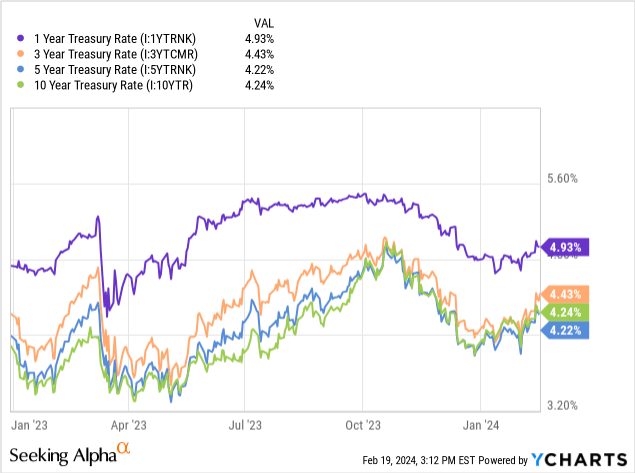
Treasury yields have risen since early 2023, with benchmark 10y treasury charges rising from 3.9% to 4.2%. Yields rose resulting from Federal Reserve hikes, and expectations of considerably restrictive coverage shifting ahead (increased for longer).
Information by YCharts
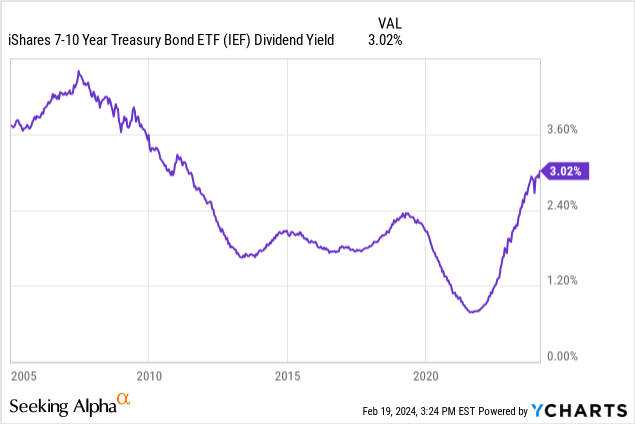
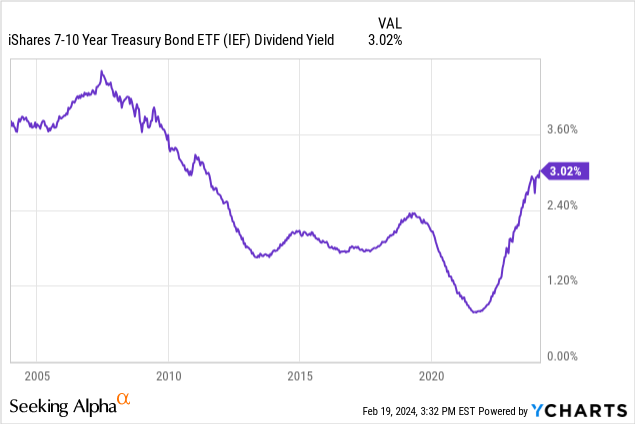
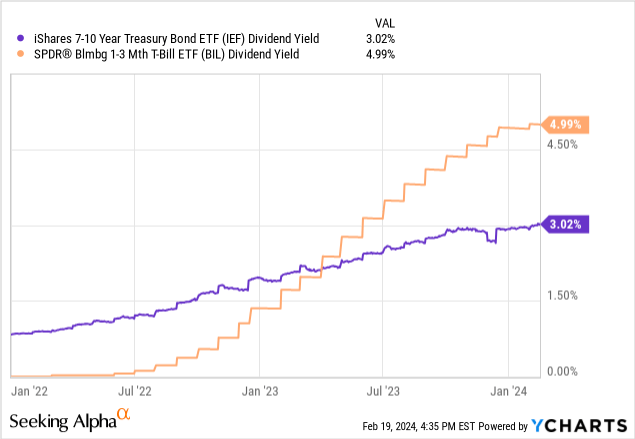
IEF itself has seen its yield enhance from 2.0% to three.0%.
Information by YCharts
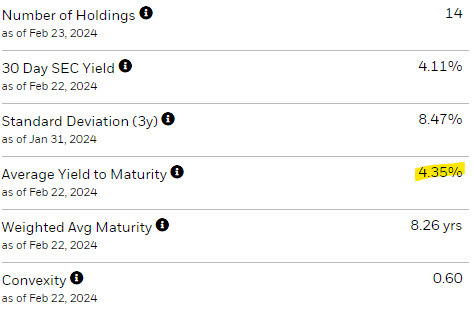
IEF’s yield stays decrease than treasury charges, because the fund nonetheless comprises a number of older treasuries with a lot decrease coupon charges. These have decrease costs, so anticipated complete returns, together with potential capital beneficial properties from treasuries maturing at par, are increased, and just like these of treasuries themselves. IEF sports activities a 4.4% yield to maturity, akin to prevailing treasury charges, as anticipated.
IEF
Treasury yields are at their highest ranges because the monetary disaster / housing bubble, however have been usually increased throughout prior many years. Financial circumstances have materially modified since, so specializing in more moderen years appears acceptable.
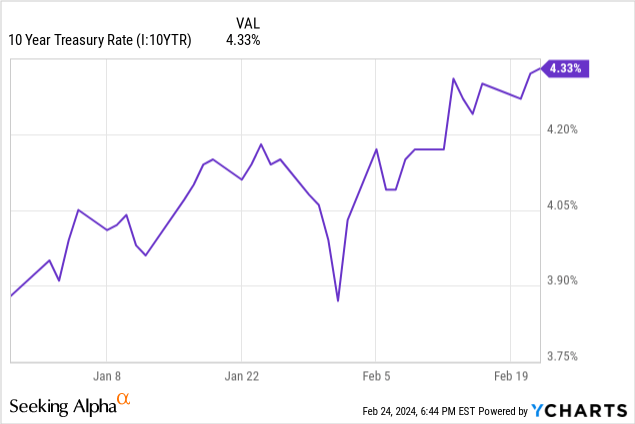
IEF’s yield can be highest because the monetary disaster, however was a bit increased throughout the 2000s.
Information by YCharts
Greater treasury yields will nearly definitely result in increased treasury returns long-term, an vital, easy profit for traders. IEF itself is a materially stronger funding alternative now than final 12 months, too.
Potential Federal Reserve Cuts
The Federal Reserve is guiding for 3 charge cuts this 12 months. Though charge cuts are usually not sure, they appear extremely probably, and most traders and analysts anticipate them to happen. Fed charge cuts ought to put strain on treasury yields, with two vital implications.
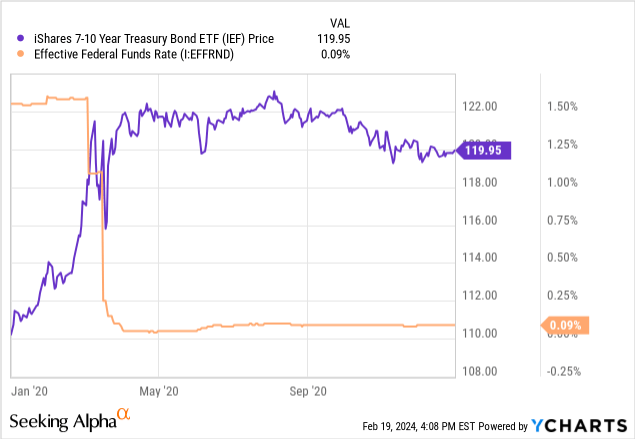
First, decrease Fed charges ought to result in increased treasury costs short-term. Keep in mind, treasuries are fixed-rate investments, so Fed coverage has no influence on current treasury coupon charges. If charges go down, at the moment current treasuries ought to proceed to yield +4.0%, and people charges would begin to look very engaging as soon as Fed charges are close to 2.0-3.0%. Demand for these older, higher-yielding treasuries ought to spike, resulting in increased treasury costs. The identical ought to be true for IEF. For instance, IEF’s share worth elevated from $110 to $120 throughout 2020, because the Fed slashed charges as a result of pandemic.
Information by YCharts
Do keep in mind, the above depends on the magnitude and velocity of any potential charge cuts. I might not anticipate increased treasury costs from a 0.25% charge minimize in late 2025, I would anticipate them if charges are slashed, as throughout the pandemic. In apply, I anticipate charge cuts someplace between these two extremes, so increased treasury costs are a considerably unsure risk. Nonetheless, an vital one.
The second implication of decrease Fed charges is decrease treasury long-term returns. Charges go down, yields decline, returns go down. Appears easy sufficient however, once more, vital to say. Insofar as this can be a risk or concern, traders ought to gravitate in direction of investing in longer-term treasuries, to lock-in charges.
For my part, charges are more likely to stay increased for longer, not less than relative to market expectations and costs. As such, I don’t suppose that treasury costs will considerably enhance, nor potential returns lower, within the coming months.
Treasury Peer Comparability
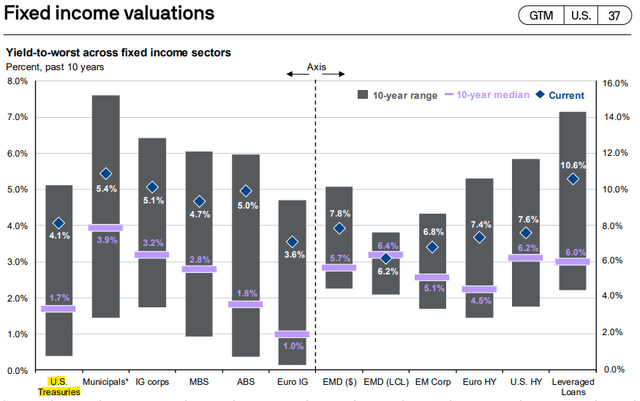
Attributable to latest Federal Reserve hikes, most bonds and bond sub-asset courses have seen increased yields. Treasuries are usually not particular in that regard, though treasury yields have risen a bit increased than common, particularly when in comparison with different investment-grade securities like municipal bonds and MBS.
JPMorgan Information to the Markets
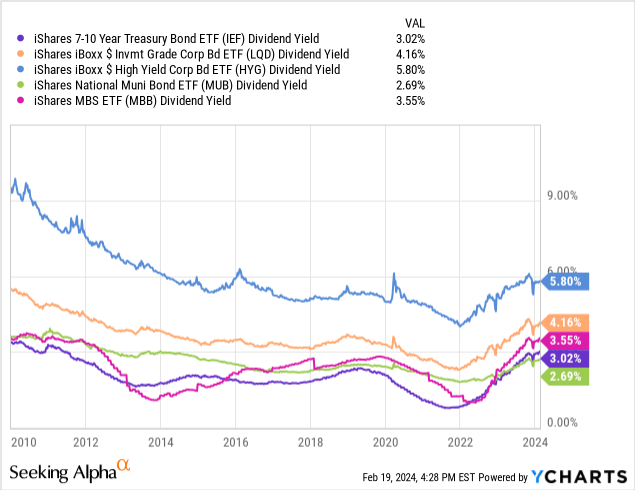
The identical is usually true of bond funds, most of which have seen their yields rise to decades-highs. The iShares iBoxx $ Excessive Yield Company Bond ETF (HYG) appears to be an exception, and I am usually uncertain why. Contemplating high-yield bond traits, the fund ought to be buying and selling at a a lot increased yield than common. Dividends have risen since early 2022, not less than.
Information by YCharts
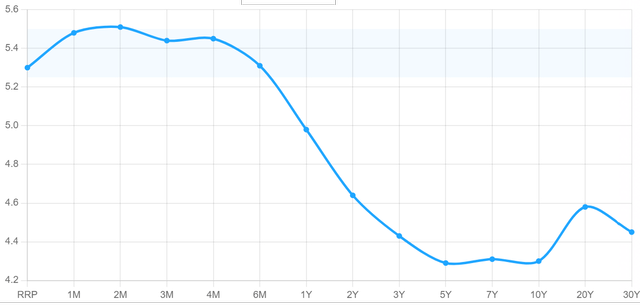
Attributable to expectations of near-term charge cuts and Fed steerage, the yield curve is inverted, with short-term securities usually yielding lower than long-term securities. For instance, t-bills yield 5.3% proper now, in comparison with 4.3% for 10y treasuries.
U.S. Treasury Yield Curve
The identical is true for IEF and t-bill funds.
Information by YCharts
So, treasuries are a lot stronger funding alternatives now than prior to now, however the identical is true of most bonds and bond sub-asset courses. A few of appear stronger than treasuries, too, providing increased yields or different advantages.
BOXX achieves t-bill like returns by choices, offering some potential tax advantages to traders.
JAAA invests in high-quality CLO debt tranches. Threat and volatility are each extraordinarily low, whereas the fund yields 6.2%.
BOXX is a short-term fund whereas JAAA’s underlying holdings are variable charge, so neither can be utilized to lock-in charges, in contrast to IEF or treasuries. I nonetheless choose the pair to IEF, however that is a crucial distinction.
Wanting Again
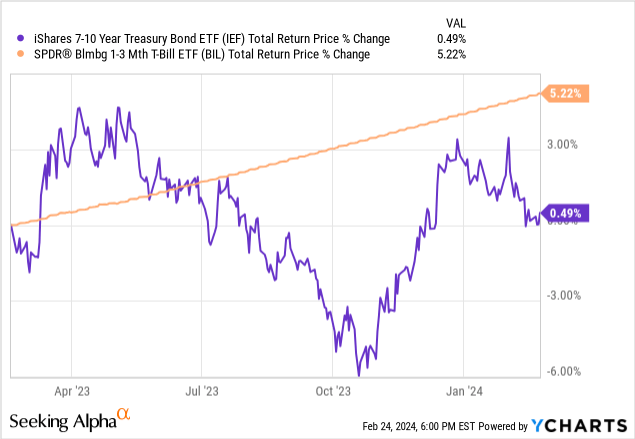
In my final article on treasuries, I argued that t-bills have been a a lot stronger funding alternative, resulting from their increased yields and decrease charge danger. T-bills have outperformed since, in-line with expectations.
Information by YCharts
Since then, treasury yields have risen, inflation has eased, and the Fed appears poised to start out reducing charges. As such, treasuries look like a lot stronger funding alternatives now than prior to now.
Conclusion
IEF’s dividend yield has risen, an vital profit for the fund and its shareholders. Decrease charges would possibly yield some short-term advantages, however the long-term influence will nearly definitely be destructive. Though IEF is a a lot stronger funding now than earlier than, different decisions look even stronger, together with JAAA and BOXX.
from Finance – My Blog https://ift.tt/CsmgQNj
via IFTTT
.jpg)


No comments:
Post a Comment